
Wednesday, December 18, 2013
Yay! 2000!
I've just reached my first milestone when it comes to my blog - 2000 page views! Thank you everyone who reads this blog!!


How I Sculpt a Tail Part One - Creating the Tail Bone
So, I thought I'd show you how I sculpt a tail. This is the technique that has worked out for me multiple times.
Supplies:


Supplies:
- A body model
- Dremel (or a saw and an electric drill)
- Apoxie (I use Magic Sculpt but I've also used Ave's Apoxie Sculpt with success. If you are just starting out, you can use jewelry apoxie that is available at Michaels)
- Armature wire
- Tin Foil
- Heat Gun/ Hair Dryer
- Baking Soda
- Super Glue
- References! References! References!

After smoothing down the inevitable rough plastic caused by the tail removal surgery with sand paper, there may be a large hole left by the tail, due to the model be hollow cast. This would be the case for most Breyer horses. The only size, that isn't like this is the Stablemates.
To fill this hole, squirt some hot glue in and stuff aluminum foil in the hole. When it is just about filled, use your apoxie to finish filling it. Let cure (usually 24 hours, but read your specific product's directions). When it is cured, drill a hole where the tailbone would be.

The next thing you want to determine is tail set. This is where your references come in. Since I'm doing an Akhal-Teke, I want it to be very low. How ever if I wanted to do an Arabian I would make the tail set much higher, especially because it is a very recognizable characteristic of the breed.
 |
| A high set tail vs a low set tail See the difference? |
So once you've determined the set of your tail, insert some of the armature wire into the hole you've created in the last step. Bend it until you have matched the set of your reference's tail. Through out the process of sculpting the hair, this wire will act as your "tail bone."
Now is also the time to add the base of movement. Is the tail blowing gently in the wind? Is it flicking irritably at flies? Is it still? I can not stress how important references are especially if there is movement in the tail.

Notice how I have excess wire still? I save cutting off the excess until the wire is firmly glue in the hole, just in case I change my mind about the length of the tail.
In order to secure the tail drip super glue into the hole and sprinkle a bit of baking soda on it. This immediately dries the glue and creates a strong bond (this does create a bit of heat due to it being a chemical reaction, so be careful!)
 |
| the super glue is soaking up the baking soda |
The next step is to trim the length of withe to your preference. Again - references! References! References! My ref horse does not have a very long tail, so I'm going to cut the wire right below the hock.

Congratulations! You've just created a tail bone. This post was originally going to be one whole post all about sculpting a tail, but I'm going to need to split it up in to two different posts. The next installment will be about adding the hair texture.
Sunday, December 15, 2013
'Tis the Season
So with only ten more days until Christmas, I decided to take a sanity break from studying for midterms and decorate my studio! And of course it's a horse themed tree!
 |
| On the left is my prepping/sculpting table and on the right is my painting/detailing table |

The tree is decorated with horse themed ribbon, various horse ornaments, and Breyerfest magnets that I have collected on my trips there.
Tuesday, December 10, 2013
Prepping Day (or rather Prepping Night)
 |
| The (willing) victims |
The first up is an old Secretariat classic resculpted to a Chincoteague pony who had an unfortunate run in with a bad can of primer.

The next is the new Black Beauty classic model, who has just been sitting around in my body box.

And finally is the little foalie that had primer issues earlier.
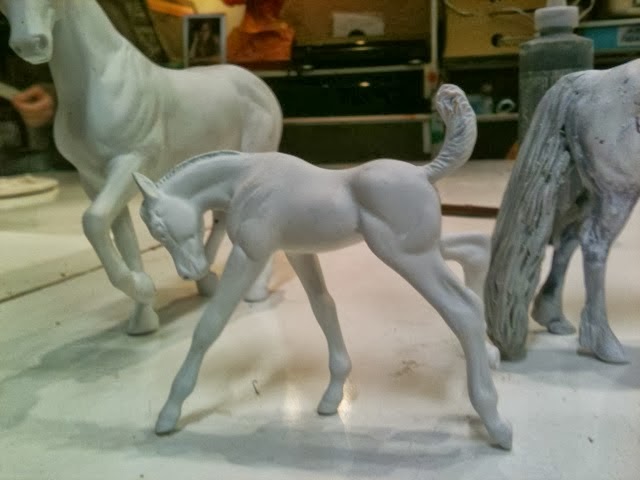
So in the end I was able to sand off most of the bad primer for the resculpt


The classic got resculpted feet and was sanded a bit


Keep an eye out on my blog an my Etsy page for an upcoming sales piece!
Friday, August 16, 2013
Off to the Beach
So I'll be at the beach for a couple days. Expect lots of pictures! Also I bought some shoes to customize, so expect updates on that.
 |
| Pic from devArt |
Thursday, August 8, 2013
A Quick, but Extremly Random, History Lesson
So last year for history and english I took British Studies We covered from the time Britain was inhabited to the end of the reign of the Plantagenet kings and the beginning of the Tudor reign, in history. In English we read the Canterbury Tales and Beowulf in the first two quarters. In the last two quarters we read Shakespeare's history plays (Henry V, Richard III, ect). Our final project for English was to write a research paper and create a website on the king or queen of our choosing. I chose Mary I aka Bloody Mary for no reason other than her nickname. But as I researched her, I realized there was much more to the queen than meets our eye.


I decided that I would share my research paper and website just incase anyone would like to read it.
THESIS STATEMENT
Due to abuse in childhood and a pre-existing mental condition, Mary I’s phantom pregnancy triggered a depressive and fragile mental state that allowed a genocidal rampage influenced by her strong Catholic sympathies.
PURPOSE STATEMENT
Using various historical references, it will be proved that Mary I had pre-existing conditions, that skewed her judgment, in religious matters.
INTRODUCTION
When Mary was a teenager, her mother, Katherine of Aragon was discarded in favor of Anne Boleyn, Mary was broken hearted. Her new stepmother threatened her with death and heaped other abuses on her. Mary also had a disorder called amenorrhea, which symptoms include depression. In order to marry Anne Boleyn, Henry VIII had to break away from the Catholic Church. This religion was the religion Mary I grew up with and loved. She was devastated when the break happened, and longed to return the country to the true religion.
HER TROUBLED CHILDHOOD
In the years after Mary I was born, she was doted upon by Katherine of Aragon, “[r]oyal children were traditionally given their own establishments, but as a precious only child Mary was rarely too far away from the court, so that Katherine could visit her frequently. In this way, she forged a close bond with her daughter”(Waller 18). She was also doted upon by Henry VIII to a lesser degree. Henry VIII had less contact with his daughter but still found it necessary to show her love when the moment suited him. During particular days in the court, Henry VIII would bring out his daughter for all to admire. She was beautiful, talented, and that reflected well on Henry (19).
When Henry VIII married Anne Boleyn, Mary’s life was forever changed. She was declared illegitimate and downgraded to the title of Lady Mary, “[p]rincess and pronounced illegitimate…her stepmother only eight years her senior” (Ross 20). Mary was forced to be subservient to a woman who was only eight years older than her, but she refused to accept this lot in life. Anne Boleyn’s tactics to get Mary to cooperate were to starve her and box her ears if she used the title princess. (Whitelock 57) Anne always resented Mary, and she “always treated Mary with calculated cruelty, heaping humiliations on her and urging the king to have her put to death” (Weir 2). On top of that “[h]er ‘wicked’ stepmother ordered her to wait on the sibling who had supplanted her [Elizabeth I] as heir to England, and threatened to force her into a base marriage or poison her” (Waller 15).
However, it was not only Anne who heaped cruelties on Mary. Her father Henry VIII resented the fact that not only did she still practice as a Catholic, she seemed to embrace the religion fully when Henry VIII started his religious reforms. To remedy this he sent a delegation of men to change her views. When she refused, they turned nasty, one said “that if she were his daughter, he would beat her to death. He would knock her head against a wall until it was as soft as a boiled apple…Then they left, telling her she had four days to think it over”(36). Naturally she feared for her life, and gave in, believing that God would forgive her (36).
HER PYSCOLOGICAL STATE BEFORE AND AFTER THE PHANTOM PREGANCY
Mary I suffered from a disease called amenorrhea, the symptoms of amenorrhea, which is the irregularity of menstrual periods, include depression, headaches, vomiting, palpations, difficulty in breathing, and abdominal swelling (27). She also suffered from a “profound melancholy” like her grandmother Isabella and her cousin Charles (27). Her depression increased after her phantom pregnancy.
Anne Boleyn’s abuse also affected Mary’s mental state. This abuse made her more likely to break under stress, “[e]xposure to complex and chronic trauma [caused by abuse in childhood or adolescence] can result in persistent psychological problems. Complex trauma affects the developing brain and may interfere with a child's capacity to integrate sensory, emotional and cognitive information, which may lead to over-reactive responses to subsequent stress” (Lamont). As a queen she was under the pressure to have a male heir and when her first pregnancy proved to be false, she started cracking and the burnings of heretics increased. This is most prominently shown at the execution of Bishop Cranmer.
When Mary I announced her pregnancy the court was overjoyed but as the months went by it became apparent that she was not pregnant. She probably “suffered from pseudocyesis, a rare psychological condition commonly known as phantom pregnancy…The woman believes she is pregnant and the resultant trauma, when she finds that this is not the case, can be very damaging to her mental health” (Weir 314). She longed to be with child, as she was getting well into middle age, and her chances to have a child decreased. After this phantom pregnancy, the burnings of heretics increased, because “the queen was preoccupied with her phantom pregnancy and depressed in its aftermath…The burnings took on a momentum of their own and Mary was too lethargic to stop it” (Waller 100). The depression had increased, and she was unable to care enough to think about the ramifications the increase of burnings brought.
THE BURNINGS
Mary I, almost from birth, had been immersed in the Catholic theology. She was heartbroken when England turned away from her beloved Church. She even refused to change her religion, “[t]hings grew difficult [during Edward VI’s reign]…because she refused to change her religion” (Ross 22). When she took power, she intended to return the country to the Catholic Church. However, she was cautioned to not take the conversion to quickly. That advice was countermanded by Cardinal Pole, who was the papal legate to England. He played a huge role in convincing Mary to bring England back into the Catholic fold almost immediately. He claimed that it was sacrilegious to do otherwise (Whitelock 268-271). She listened and started the reforms immediately,“[t]he secular authorities were empowered once more to deal ruthlessly with religious opponents: seditious word and activities would be punished” (281). Mary I’s policy of punishment was burning heretics at the stake. (Ross 104)
Her careful composure during this time belied a brittle sanity liable to break under more stress (Erikson 462). Bishop Cranmer was the man in Mary’s eyes who caused all her troubles with her brother and father. He had been kept in the Tower and asked to recant, to save his soul, and he did. She momentarily broke and Mary went ahead with the execution (Waller 104-105). This over reaction was caused by her personal grudge Mary held against this man. In the same way Mary held a grudge against the Protestants who had supplanted the Catholic Church in England, which was the rightful church in Mary’s mind.
CONCLUSION
Mary I’s abusive childhood and underlying mental condition can be blamed for her overreaction that was the persecution of Protestants. Anne Boleyn heaped abuse on Mary and she had a condition that caused depression. She also was a very zealous Catholic who was devastated when England broke from the Church.
Due to abuse in childhood and a pre-existing mental condition, Mary I’s phantom pregnancy triggered a depressive and fragile mental state that allowed a genocidal rampage influenced by her strong Catholic sympathies.
PURPOSE STATEMENT
Using various historical references, it will be proved that Mary I had pre-existing conditions, that skewed her judgment, in religious matters.
INTRODUCTION
When Mary was a teenager, her mother, Katherine of Aragon was discarded in favor of Anne Boleyn, Mary was broken hearted. Her new stepmother threatened her with death and heaped other abuses on her. Mary also had a disorder called amenorrhea, which symptoms include depression. In order to marry Anne Boleyn, Henry VIII had to break away from the Catholic Church. This religion was the religion Mary I grew up with and loved. She was devastated when the break happened, and longed to return the country to the true religion.
HER TROUBLED CHILDHOOD
In the years after Mary I was born, she was doted upon by Katherine of Aragon, “[r]oyal children were traditionally given their own establishments, but as a precious only child Mary was rarely too far away from the court, so that Katherine could visit her frequently. In this way, she forged a close bond with her daughter”(Waller 18). She was also doted upon by Henry VIII to a lesser degree. Henry VIII had less contact with his daughter but still found it necessary to show her love when the moment suited him. During particular days in the court, Henry VIII would bring out his daughter for all to admire. She was beautiful, talented, and that reflected well on Henry (19).
When Henry VIII married Anne Boleyn, Mary’s life was forever changed. She was declared illegitimate and downgraded to the title of Lady Mary, “[p]rincess and pronounced illegitimate…her stepmother only eight years her senior” (Ross 20). Mary was forced to be subservient to a woman who was only eight years older than her, but she refused to accept this lot in life. Anne Boleyn’s tactics to get Mary to cooperate were to starve her and box her ears if she used the title princess. (Whitelock 57) Anne always resented Mary, and she “always treated Mary with calculated cruelty, heaping humiliations on her and urging the king to have her put to death” (Weir 2). On top of that “[h]er ‘wicked’ stepmother ordered her to wait on the sibling who had supplanted her [Elizabeth I] as heir to England, and threatened to force her into a base marriage or poison her” (Waller 15).
However, it was not only Anne who heaped cruelties on Mary. Her father Henry VIII resented the fact that not only did she still practice as a Catholic, she seemed to embrace the religion fully when Henry VIII started his religious reforms. To remedy this he sent a delegation of men to change her views. When she refused, they turned nasty, one said “that if she were his daughter, he would beat her to death. He would knock her head against a wall until it was as soft as a boiled apple…Then they left, telling her she had four days to think it over”(36). Naturally she feared for her life, and gave in, believing that God would forgive her (36).
HER PYSCOLOGICAL STATE BEFORE AND AFTER THE PHANTOM PREGANCY
Mary I suffered from a disease called amenorrhea, the symptoms of amenorrhea, which is the irregularity of menstrual periods, include depression, headaches, vomiting, palpations, difficulty in breathing, and abdominal swelling (27). She also suffered from a “profound melancholy” like her grandmother Isabella and her cousin Charles (27). Her depression increased after her phantom pregnancy.
Anne Boleyn’s abuse also affected Mary’s mental state. This abuse made her more likely to break under stress, “[e]xposure to complex and chronic trauma [caused by abuse in childhood or adolescence] can result in persistent psychological problems. Complex trauma affects the developing brain and may interfere with a child's capacity to integrate sensory, emotional and cognitive information, which may lead to over-reactive responses to subsequent stress” (Lamont). As a queen she was under the pressure to have a male heir and when her first pregnancy proved to be false, she started cracking and the burnings of heretics increased. This is most prominently shown at the execution of Bishop Cranmer.
When Mary I announced her pregnancy the court was overjoyed but as the months went by it became apparent that she was not pregnant. She probably “suffered from pseudocyesis, a rare psychological condition commonly known as phantom pregnancy…The woman believes she is pregnant and the resultant trauma, when she finds that this is not the case, can be very damaging to her mental health” (Weir 314). She longed to be with child, as she was getting well into middle age, and her chances to have a child decreased. After this phantom pregnancy, the burnings of heretics increased, because “the queen was preoccupied with her phantom pregnancy and depressed in its aftermath…The burnings took on a momentum of their own and Mary was too lethargic to stop it” (Waller 100). The depression had increased, and she was unable to care enough to think about the ramifications the increase of burnings brought.
THE BURNINGS
Mary I, almost from birth, had been immersed in the Catholic theology. She was heartbroken when England turned away from her beloved Church. She even refused to change her religion, “[t]hings grew difficult [during Edward VI’s reign]…because she refused to change her religion” (Ross 22). When she took power, she intended to return the country to the Catholic Church. However, she was cautioned to not take the conversion to quickly. That advice was countermanded by Cardinal Pole, who was the papal legate to England. He played a huge role in convincing Mary to bring England back into the Catholic fold almost immediately. He claimed that it was sacrilegious to do otherwise (Whitelock 268-271). She listened and started the reforms immediately,“[t]he secular authorities were empowered once more to deal ruthlessly with religious opponents: seditious word and activities would be punished” (281). Mary I’s policy of punishment was burning heretics at the stake. (Ross 104)
Her careful composure during this time belied a brittle sanity liable to break under more stress (Erikson 462). Bishop Cranmer was the man in Mary’s eyes who caused all her troubles with her brother and father. He had been kept in the Tower and asked to recant, to save his soul, and he did. She momentarily broke and Mary went ahead with the execution (Waller 104-105). This over reaction was caused by her personal grudge Mary held against this man. In the same way Mary held a grudge against the Protestants who had supplanted the Catholic Church in England, which was the rightful church in Mary’s mind.
CONCLUSION
Mary I’s abusive childhood and underlying mental condition can be blamed for her overreaction that was the persecution of Protestants. Anne Boleyn heaped abuse on Mary and she had a condition that caused depression. She also was a very zealous Catholic who was devastated when England broke from the Church.
She has become my favorite queen of England. Thank you for reading(or skimming) this post!
Monday, August 5, 2013
Updates
Ack! Sorry about the radio silence! Between BreyerFest, a wedding, and a camp I attend, my past two weeks have been tied up! In other news happy August! For some of you (including me) that means school is starting in a couple weeks (bleh)! Surprisingly, my schedule was actually correct this year, save for one class which turns out it wasn't offered this year :-).
My first accessory this year is a bag --->


I have a couple more things to make so when they're close to being done, I'll post them.
My first accessory this year is a bag --->


Next I have an WIP planner


I have a couple more things to make so when they're close to being done, I'll post them.
 |
| because he's adorable |
Subscribe to:
Posts (Atom)